
If you spend even a little time on Snapchat, Instagram, TikTok, or WhatsApp, you’ve probably seen someone write “ASF” at the end of a sentence. It usually appears in casual chats like “I’m tired asf” or “that movie was funny asf,” leaving many people wondering what it actually means.
The confusion is understandable because ASF isn’t a word on its own. It’s a slang intensifier that changes the tone of a sentence completely. For new users, especially those not deeply familiar with Gen Z texting culture, it can look strange or even confusing.
In simple terms, ASF is used to emphasize something strongly, but its tone depends heavily on context. Understanding it helps you read messages more accurately and avoid misinterpreting emotions in digital conversations.
ASF – Quick Meaning
What ASF stands for
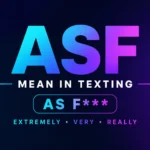
ASF is a shortened form of the phrase “as f***.” It is used as an intensifier, meaning “very” or “extremely.”
It is commonly used in casual digital communication to exaggerate feelings, emotions, or descriptions.
Simple definition
- ASF = “as f***”
- Used to intensify adjectives or emotions
- Means “very,” “extremely,” or “a lot”
Real examples
- “I’m tired asf.” → I’m extremely tired
- “That’s funny asf.” → That’s very funny
- “She’s cute asf.” → She is extremely cute
ASF is not formal language and is mostly limited to texting and social media.
Origin & Background
ASF comes from early internet slang where people shortened phrases to type faster and express emotions more strongly. The phrase “as f***” existed in spoken English long before texting, used informally to emphasize intensity.
As social media grew, especially platforms like Twitter (now X), Instagram, and TikTok, users started shortening it to ASF to make communication quicker and cleaner.
Cultural influence
Internet culture values speed, creativity, and emotional expression. ASF became popular because it delivers strong emotion in just three letters.
Social media impact
- Twitter posts made slang abbreviations mainstream
- TikTok captions spread ASF globally
- Meme culture normalized its usage
Evolution of meaning
Originally strong and expressive, ASF has now become a casual intensifier. In many cases, people use it without even thinking about the literal phrase behind it.
Real-Life Conversations (MANDATORY)
WhatsApp conversation
Person A: How was your exam?
Person B: Hard asf 😭 I barely finished it
Instagram DM
Person A: Did you like the outfit I posted?
Person B: Yes bro, you look clean asf 🔥
TikTok comment section
User 1: This dance is trending everywhere
User 2: It’s addictive asf, I’ve watched it 20 times
Text message
Person A: Are you coming to the party?
Person B: Yes, I’m excited asf!!!
These examples show how ASF adapts depending on emotion, tone, and situation.
Emotional & Psychological Meaning
ASF is not just slang—it reflects how people exaggerate emotions in modern digital communication. It adds intensity to feelings that might otherwise feel flat in text.
What emotion it expresses
ASF usually expresses:
- Excitement (“happy asf”)
- Frustration (“annoyed asf”)
- Attraction (“hot asf”)
- Exhaustion (“tired asf”)
Why people use it
People use ASF because text messages lack tone. In real life, voice and facial expressions show emotion. Online, ASF helps fill that gap.
What it reveals about communication today
Modern communication is fast, emotional, and expressive. ASF shows how people prefer short, impactful language over full sentences.
Real-world scenario
Imagine someone texting after a long day:
“I’m tired.”
Now compare:
“I’m tired asf.”
The second version instantly feels more emotional and relatable.
Usage in Different Contexts
Social media
ASF is extremely common in captions, comments, and memes. It helps users sound expressive and relatable.
Example:
“This food is good asf 😍”
Friends & relationships
Among friends, ASF is casual and natural. It is often used to exaggerate emotions.
Example:
“You’re annoying asf but I still love you 😂”
Work / professional settings
ASF should never be used in formal or workplace communication. It is considered inappropriate and unprofessional.
Incorrect:
“The report is delayed asf.”
Correct:
“The report is very delayed.”
Casual vs serious tone
- Casual: Common and accepted
- Serious: Avoid completely
- Emotional texts: Often used for emphasis
When NOT to Use It
In professional communication
Emails, reports, and workplace chats should avoid slang like ASF.
In respectful or formal conversations
Teachers, managers, or elders may misinterpret it as disrespectful.
In sensitive situations
Using ASF in serious topics (health, grief, conflict) can feel inappropriate or insensitive.
Common Misunderstandings
Thinking ASF is a word
ASF is not a real dictionary word. It is an abbreviation of slang.
Assuming it always means anger
ASF does not always mean negative emotion. It depends on context.
Misreading tone
“I’m bored asf” is different from “I’m bored.” The first is more intense, not necessarily angry.
Literal confusion
Some beginners think ASF is an acronym with a separate meaning. In texting culture, it simply intensifies adjectives.
Comparison Table
| Expression | Meaning | Tone | Usage |
|---|---|---|---|
| ASF | Extremely / as f*** | Strong informal | Social media, texting |
| Very | Basic intensity | Neutral | Formal & informal |
| Super | Strong intensity | Friendly | Casual conversation |
| As hell | Similar to ASF | Strong informal | Spoken & texting |
| Mad | Very (slang) | Informal | Gen Z speech |
| Extremely | High intensity | Formal | Academic, professional |
| Slightly | Opposite intensity | Mild | Neutral |
| Barely | Almost not | Negative mild | Formal/informal |
Key Insight
ASF is one of the strongest informal intensifiers in texting culture. It carries more emotional weight than “very” or “super,” making it popular among younger users who prefer expressive communication.
Variations / Types
ASF (standard form)
Most common form meaning “as f***.”
asf (lowercase)
Casual typing style with same meaning.
ASF!!! (emphasized)
Used to show extra excitement or emotion.
asf 😂
Adds humor or sarcasm.
so asf
Redundant but used for exaggeration in informal texting.
that’s asf
Used to react strongly to something.
happy asf
Expression of strong happiness.
tired asf
Expression of exhaustion.
funny asf
Used for strong humor reactions.
lit asf
Used to describe something extremely cool or exciting.
How to Respond When Someone Uses It
Casual replies
- “Haha same 😂”
- “I feel that”
- “True asf”
Funny replies
- “Relax bro, not that deep 😂”
- “Why you so dramatic asf?”
Mature replies
- “I understand, that sounds intense.”
- “Hope it gets easier for you.”
Respectful replies
- “Got it, take care.”
- “That sounds really overwhelming.”
Regional & Cultural Usage
Western culture
ASF is widely used in the US, UK, and Canada among Gen Z and millennials.
Asian culture
Used mainly in urban youth communities familiar with English slang and social media trends.
Middle Eastern culture
Less common in formal spaces but widely understood in online youth conversations.
Global internet usage
ASF is now a global slang term due to TikTok, Instagram, and meme culture.
Generational differences
- Gen Z: Uses ASF frequently and naturally
- Millennials: Understand it but use it less
- Older generations: Often confused by it
Is It Safe for Kids?
ASF is informal slang that contains a censored form of a swear word. While it is common online, it is not considered appropriate for young children.
Teenagers often encounter it on social media, but parents and educators usually discourage its use in school or formal communication.
The key concern is not danger, but appropriateness and context awareness.
FAQs
What does ASF mean in texting?
ASF means “as f***” and is used to intensify emotions or descriptions.
Is ASF a bad word?
It includes a censored swear word, so it is informal and not suitable for formal use.
Can ASF be used in school chats?
It is not recommended for academic or professional environments.
Does ASF always mean something negative?
No, it can express both positive and negative emotions depending on context.
What is the difference between ASF and AF?
Both mean the same thing, but ASF is a slightly more stylized or spaced version.
Why do people use ASF instead of “very”?
Because it sounds more emotional, modern, and expressive in casual texting.
Conclusion
ASF is a small piece of internet slang, but it carries strong emotional weight in digital conversations. It helps people express intensity in a fast, relatable way that fits modern texting culture.
Understanding ASF is not just about knowing a meaning—it’s about understanding how language evolves online. From excitement to frustration, it adds personality to messages that would otherwise feel plain.
Used correctly, it helps you connect better in casual conversations. Used in the wrong place, it can feel unprofessional. The key is knowing the context and audience.