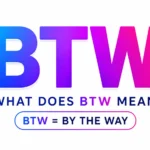

If you’ve spent any time texting, scrolling through social media, or chatting online, you’ve probably come across the abbreviation “BTW.” Many people search for “what dose btw mean” because they see it in messages but aren’t completely sure how it’s being used.
The confusion is understandable. Digital communication moves fast, and abbreviations often carry subtle meanings beyond their dictionary definitions. A simple three-letter acronym can change the tone of a conversation, add extra information, or make a message feel more casual.
Understanding BTW helps you communicate more naturally online and prevents misunderstandings when talking with friends, family, coworkers, or even strangers on social media.
In this guide, you’ll learn exactly what BTW means, where it came from, how people use it today, and when it’s appropriate—or inappropriate—to include in conversations.
What Dose BTW Mean? – Quick Meaning
Simple Definition
BTW stands for “By The Way.”
It is commonly used to introduce additional information, change the topic slightly, or mention something that wasn’t part of the main conversation.
Quick Breakdown
- BTW = By The Way
- Used in text messages, social media, emails, and chats
- Usually informal
- Helps add extra thoughts naturally
Examples
“BTW, your presentation was amazing today.”
“I’m heading out now. BTW, don’t forget your keys.”
“BTW, did you ever watch that movie I recommended?”
In each example, BTW introduces a new piece of information without completely changing the conversation.
Origin & Background
Where Did BTW Come From?
The phrase “by the way” has existed in English for centuries. Long before smartphones existed, people used it in spoken conversations to add extra thoughts.
As internet communication became more common during the 1990s, users started shortening frequently used phrases. This led to the creation of abbreviations such as:
- LOL
- BRB
- IMO
- BTW
BTW quickly became popular because it saved time and felt natural in online conversations.
Cultural Influence
Text messaging culture encouraged people to communicate quickly. Character limits on early mobile phones and social media platforms pushed users toward shorter expressions.
As a result, BTW became part of everyday digital language.
Social Media Impact
Social media accelerated the popularity of BTW.
Platforms such as Instagram, TikTok, Facebook, and X encouraged fast interactions. Users began inserting BTW into captions, comments, and private messages.
Today, many people use BTW without even thinking about its original meaning.
How Its Meaning Evolved
Although BTW still means “by the way,” its purpose has expanded.
People now use it to:
- Share side information
- Add compliments
- Bring up forgotten details
- Introduce sensitive topics gently
- Transition between ideas
Real-Life Conversations
WhatsApp Conversation
Person A:
Hey, are we still meeting at 7?
Person B:
Yeah, see you then.
Person B:
BTW, Sarah is coming too.
Instagram DM
Person A:
Your vacation photos look incredible.
Person B:
Thank you!
Person A:
BTW, where was that beach?
TikTok Comment
Person A:
This recipe actually worked.
Person B:
Same here.
Person B:
BTW, I added extra garlic and it tasted even better.
Text Message
Person A:
Good luck with your interview today.
Person B:
Thanks, I’m nervous.
Person A:
BTW, you’ve prepared more than enough. You’ll do great.
These examples show how BTW naturally introduces additional information while keeping conversations relaxed.
Emotional & Psychological Meaning
What Emotion Does BTW Express?
BTW itself doesn’t carry strong emotions.
Instead, it acts as a bridge between ideas.
Depending on context, it can communicate:
- Friendliness
- Curiosity
- Support
- Excitement
- Casual confidence
Why People Use It
People often think faster than they type.
During conversations, they suddenly remember something important. BTW gives them a simple way to insert that thought without sounding awkward.
What It Reveals About Modern Communication
Modern communication values speed and efficiency.
People want messages that feel natural and conversational rather than formal and structured.
BTW helps achieve that balance.
Personal-Style Scenario
Imagine texting a close friend after a difficult week.
You discuss work, family, and daily life. Suddenly you remember that they received good news recently.
You might write:
“BTW, congratulations on your promotion. I’m really happy for you.”
That small phrase creates a smooth transition while keeping the conversation warm and genuine.
Usage in Different Contexts
Social Media
On social media, BTW is extremely common.
Examples:
- “BTW, link is in my bio.”
- “BTW, thank you for all the support.”
It helps creators add extra information without making posts feel overly formal.
Friends & Relationships
Friends frequently use BTW because it feels relaxed and conversational.
Examples:
- “BTW, I miss hanging out with you.”
- “BTW, your birthday gift is finally here.”
Work and Professional Settings
BTW can sometimes appear in workplace chats.
Examples:
- “BTW, the meeting has been moved to Friday.”
- “BTW, I’ve attached the updated document.”
However, professional use depends on company culture.
Casual vs Serious Tone
Casual:
“BTW, that movie was hilarious.”
Serious:
“BTW, we need to discuss next month’s budget.”
Although the abbreviation remains the same, the surrounding message changes the tone.
When NOT to Use It
Formal Business Documents
Avoid BTW in:
- Legal documents
- Academic papers
- Official reports
Use “by the way” or a more formal transition instead.
Sensitive Conversations
In emotional discussions, BTW may sound careless.
Example:
“BTW, sorry about your loss.”
This can feel insensitive because it minimizes the importance of the topic.
Cultural Considerations
Some people, particularly older generations, may prefer complete sentences over abbreviations.
Understanding your audience is important.
Potential Misunderstandings
Using BTW before major news can make the information seem less important than intended.
Common Misunderstandings
People Think It Has Multiple Meanings
Unlike many internet abbreviations, BTW almost always means “by the way.”
Tone Confusion
Some readers interpret BTW as friendly.
Others may see it as abrupt.
The surrounding message usually determines the actual tone.
Assuming It Is Unprofessional Everywhere
Many workplaces use informal chat tools.
In these environments, BTW can be perfectly acceptable.
Literal vs Figurative Use
BTW isn’t meant to be analyzed literally.
Its purpose is simply to guide conversation flow.
Comparison Table
| Expression | Meaning | Tone | Common Usage |
|---|---|---|---|
| BTW | By The Way | Casual | Extra information |
| FYI | For Your Information | Neutral | Sharing facts |
| IMO | In My Opinion | Personal | Giving opinions |
| TBH | To Be Honest | Direct | Honest statements |
| BRB | Be Right Back | Informal | Temporary absence |
| ASAP | As Soon As Possible | Urgent | Requests |
| Nevertheless | Despite that | Formal | Professional writing |
Key Insight
BTW stands out because it isn’t mainly about emotion or opinion. Instead, it serves as a conversational connector that helps people smoothly introduce additional thoughts.
Variations / Types
BTW
Standard form meaning “By The Way.”
Btw
Same meaning with different capitalization.
btw
Lowercase version commonly used in texting.
BTW!
Adds excitement or enthusiasm.
BTW…
Creates suspense or hesitation.
Oh BTW
Introduces a remembered thought.
And BTW
Adds another related point.
BTW Thanks
Combines extra information with appreciation.
BTW Congrats
Adds congratulations naturally.
BTW Just Curious
Introduces a question casually.
How to Respond When Someone Uses It
Casual Replies
- “Good point.”
- “I didn’t know that.”
- “Thanks for telling me.”
Funny Replies
- “Plot twist!”
- “Now that’s important information.”
- “You saved the best part for last.”
Mature Replies
- “I appreciate you mentioning that.”
- “That’s helpful information.”
- “Thank you for the update.”
Respectful Replies
- “Thanks for letting me know.”
- “I understand.”
- “I’ll keep that in mind.”
Regional & Cultural Usage
Western Culture
BTW is widely accepted and commonly used in everyday communication.
Many people use it without thinking twice.
Asian Culture
Usage varies by country.
Younger generations are generally comfortable with internet abbreviations, while formal communication often avoids them.
Middle Eastern Culture
BTW appears frequently among younger internet users, especially in English-language conversations.
Formal settings typically favor complete phrases.
Global Internet Usage
The internet has made BTW almost universally recognizable among English-speaking users.
Its meaning remains remarkably consistent worldwide.
Gen Z vs Millennials
Gen Z often uses BTW alongside emojis, memes, and newer slang.
Millennials tend to use BTW in a straightforward way, similar to traditional texting habits.
Is It Safe for Kids?
Understanding Context
Yes, BTW is generally safe for kids.
It is simply an abbreviation for “by the way” and contains no offensive or inappropriate meaning.
Parents should still encourage children to understand context and audience. Knowing when informal language is appropriate is an important communication skill.
FAQs
What does BTW mean in texting?
BTW means “By The Way.” It introduces additional information or a new thought.
Is BTW rude?
No. In most situations, BTW is considered friendly and informal.
Can BTW be used in professional emails?
It depends on workplace culture. Formal business emails usually avoid abbreviations.
What is the difference between BTW and FYI?
BTW introduces a side thought, while FYI provides information for awareness.
Why do people use BTW?
People use it to add information naturally without interrupting the flow of conversation.
Is BTW still popular?
Yes. Despite newer slang terms appearing regularly, BTW remains one of the most commonly used internet abbreviations.
Should I write BTW or by the way?
For casual communication, BTW works well. In formal writing, “by the way” is usually the better choice.
Conclusion
If you’ve ever wondered what dose BTW mean, the answer is surprisingly simple. BTW stands for “By The Way” and serves as a natural way to introduce additional information in conversations.
Its popularity comes from convenience, clarity, and flexibility. Whether you’re chatting with friends, commenting on social media, or sending a quick message, BTW helps conversations flow smoothly without sounding forced.
The key is understanding your audience. In casual communication, BTW feels natural and modern. In more formal situations, spelling out “by the way” may be the smarter choice.
Once you recognize how people use BTW in everyday conversations, you’ll start noticing it everywhere—and you’ll feel confident using it yourself whenever the moment feels right.